
Jigsaw Puzzle Tips: How to Master the Impossible (No Corners Edition)
5 Jigsaw Puzzle Tips for When You Can’t Find the Corners
We have all heard the standard jigsaw puzzle tips: "Find the four corners" and "Build the border first."
But what happens when the rules change?
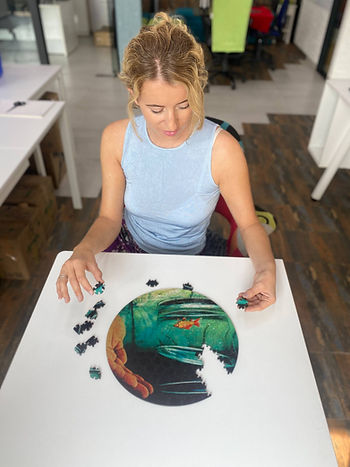
If you have picked up a Circzles puzzle, you are facing a challenge that defies traditional logic. There are no corners. The grid is hexagonal, not square. And the old strategies will only leave you frustrated.
To master a round, wooden puzzle, you need to upgrade your technique. Here are 5 advanced jigsaw puzzle tips to help you go from "stuck" to "solved."
1. The "Donut" Technique (Redefining the Border)
In a standard puzzle, the border is a square frame. In a circular puzzle, it’s a "Donut."
One of the most important jigsaw puzzle tips for round formats is to identify the Rim Pieces immediately. Look for the pieces with one smooth, curved edge.
The Strategy: Don't just pile them up. Assemble this outer ring first.
The Result: This creates a physical boundary for your workspace, giving you a clear "arena" to work inside.
2. Stop Sorting by Rows, Start Sorting by "Slices"
Most people sort pieces by broad colors (all blue here, all red there). But for a radial design—like our Sacred Geometry or Introspective themes—this isn't enough.

You need to think like a pizza chef. The image radiates from the center outward.
The Slice Method: Look for visual cues that belong to a specific "wedge" of the circle.
Cluster Building: Instead of trying to build a straight line (which doesn't exist), build small clusters of matching patterns. Connect these clusters to the outer rim you just built.
3. Master the Hexagonal Grid (The "Y" Intersection)
This is one of the more technical jigsaw puzzle tips, but it is crucial for Circzles.
Standard puzzles use a square grid where 4 pieces meet at a "+" intersection. Circzles use a Hexagonal Grid where 3 pieces often meet at a "Y" intersection.
Visual Shift: Stop looking for 90-degree corners on your pieces. Look for 120-degree angles.
The Click: Because our pieces are made of premium upcycled Sawdust, trust your hands. If the geometry feels forced, it is. The right piece will slide in with a satisfying click.
4. Work from the Center Out
If the border is giving you trouble, flip the script.
In many hard puzzles, the center is the most distinct part of the image. Find the core pieces and assemble the "bullseye" first. This gives you a second anchor point. You can then work outwards, growing the circle layer by layer until it meets your outer rim.
5. The "One-Sitting" Rule (Don't Break the Flow)
Standard advice says "take a break," but for Circzles, the best jigsaw puzzle tip is to commit.
Our puzzles are designed to be conquered in a single, deep-focus session (usually 60-90 minutes).
Don't Lose the Map: Your brain builds a temporary map of the abstract shapes while you work. If you walk away, that map fades, and you have to restart mentally.
Stay in the Zone: Stopping breaks your meditative "Flow State." Push through the challenge to experience the unmatched satisfaction of a "one-shot" victory.
Final Thought: Upgrade Your Strategy
You don't need to be a genius to solve a Circzles puzzle; you just need to be adaptable.
By using these advanced jigsaw puzzle tips—abandoning the corners, thinking in slices, and respecting the hexagonal grid—you turn a frustrating challenge into a satisfying flow.
Ready to test your new skills?
Citation Studies on expertise in puzzle solving show that experts rely less on the picture and more on "shape information" and piece geometry to solve faster. Source: Frontiers in Psychology (https://www.frontiersin.org/articles/10.3389/fpsyg.2016.01149/full)


Comments